Organizing your collection
How to organize jewelry so you can find what you own
Build a simple jewelry organization system for matching earring pairs, finding everyday pieces and separating items that need attention—without buying more storage first.
Organize around the moment you get dressed
A jewelry collection does not need to be large to become difficult to use. One earring is in a travel pouch, a favorite pendant is in its original box, and the bracelet you meant to wear is mixed with pieces awaiting repair. Start with the question your storage should answer: can you find the piece you want, together with everything needed to wear it?
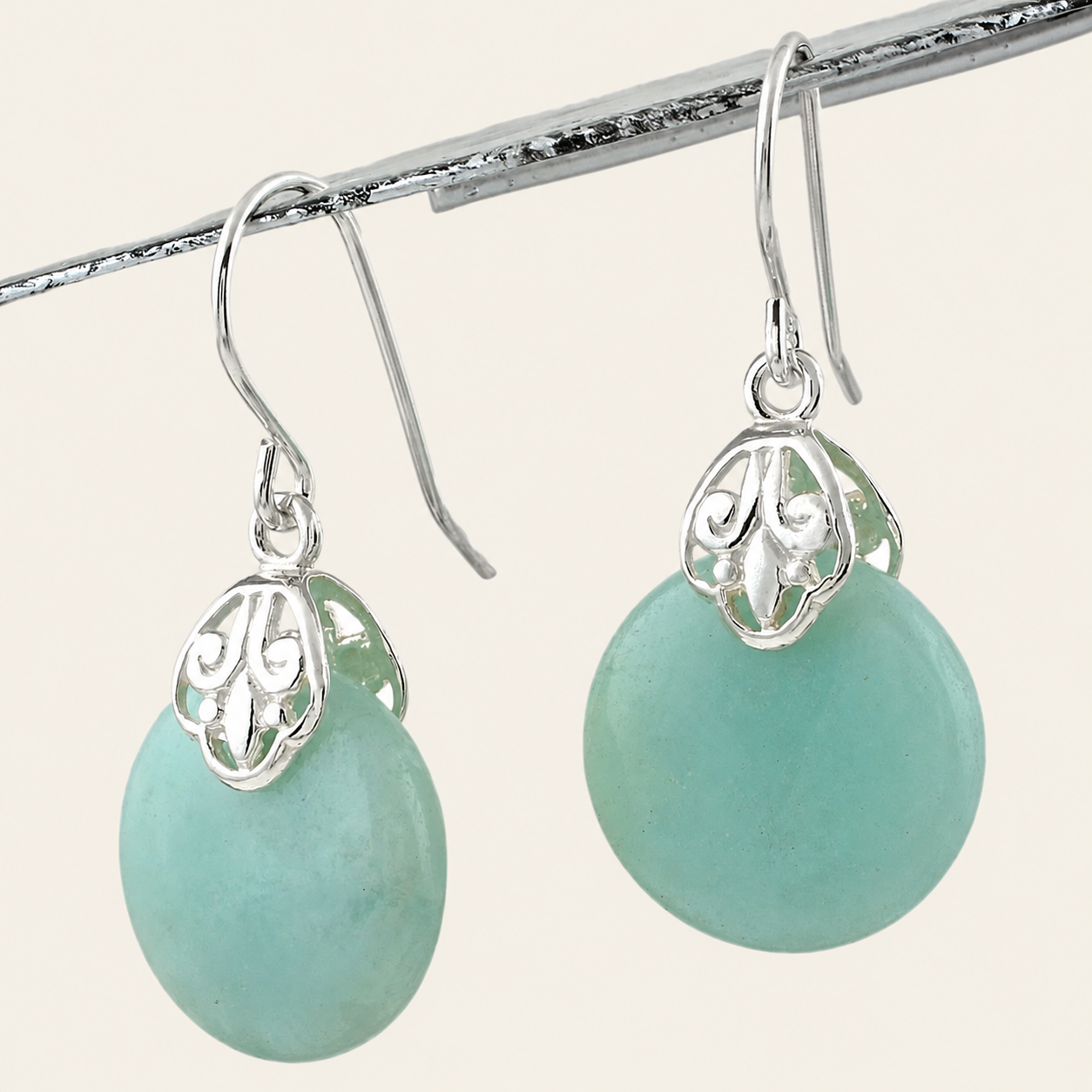
This is a guide to sorting and finding your belongings, not a material-care prescription. Keep any packaging or storage instructions supplied with a piece. The green drop earrings pictured here illustrate a matching pair; they are not a recommendation for a particular organizer or storage material.
Make three small groups before choosing containers
Work on a clear surface with a few pieces at a time. Make an everyday group, an occasional-wear group and a needs-attention group. The last group might include a single earring whose partner is missing, a piece with an uncertain fastening, or something you want a jeweler to inspect. Keeping those items apart prevents an unfinished task from becoming part of the morning search.
Choose these groups according to how you use your collection, rather than what an organizer looks like in a photograph. If you rotate the same few accessories, give those pieces an obvious home. If your choices change with work and weekend clothes, use those occasions as labels instead.
Our guide to planning a week of jewelry with fewer pieces can help you identify the small group you actually reach for. Organizing that group first gives the project a useful stopping point.
Treat an earring pair as one item
Before putting earrings away, match each pair and check that its usual backs or other removable components are accounted for. Do not assume that two similar-looking backs are interchangeable. Keep uncertain components separately until you can confirm which piece they belong to.
Give each pair an identifiable place within its existing suitable packaging or organizer. If several pairs look similar, a small label or a reference photo can distinguish them without needing to unpack everything. Use descriptions that make sense to you, such as green drops or small silver hoops, rather than elaborate categories you will forget.
For a missing partner, record what is missing and where you have already looked. One clearly labeled place for incomplete pairs is more useful than repeatedly returning a single earring to the ready-to-wear group.
Keep combinations and loose parts understandable
A pendant and chain may be worn together without needing to be stored as one tangled bundle. Keep a short note of your preferred combination if the pieces live separately. Label removable charms and their intended bracelets so that their purpose remains clear when you revisit them later.
Do not group attachments solely because they have a similar color. A visual match does not establish that their fittings work together. If you are sorting loose charms, our guide to choosing a charm for an existing bracelet explains which compatibility details to check before treating pieces as a set.
Keep receipts, product descriptions and care instructions where you can retrieve them. A folder named after the piece can be enough. There is no need to display purchase information beside the jewelry itself.
Use a short inventory to avoid buying a duplicate
For pieces you often forget, make a private list with a recognizable description, a photo and the place you keep them. Add the size or length only when you know it from a reliable record; mark an uncertain measurement as unknown rather than guessing.
The list can reveal the difference between a missing piece and a missing role. You may already own a simple chain but never find it, or you may genuinely want a different length. Our jewelry wishlist guide helps turn that second situation into a precise request with the relevant options.
Keep personal receipts and identifying information private. The purpose of the inventory is to make your own collection easier to use, not to publish a record of everything you own.
Test the system before adding more storage
Use the arrangement for several ordinary days. Notice what you still search for, which labels are unclear and what gets left outside its assigned place. Change that one part of the system before purchasing a larger organizer.
A useful reset can be very small: return complete pairs to their places, move an unresolved item to the needs-attention group and put away any loose packaging. If you need to inspect damage or assess an unfamiliar material, seek appropriate advice rather than making a storage project into a repair experiment.
The goal is not to make every piece equally visible or to arrange a perfect display. It is to know what is ready to wear, where it belongs and what still needs a decision. Stop when finding and returning your everyday pieces becomes straightforward.
Shipping & delivery · Returns & exchanges · Ask us a question